An Ayurvedic view of daily routine, recovery and the thinking behind UWAY Jeevan
- Written by Dr. Vasudha M Sharma, Senior Consultant at UWAY Health
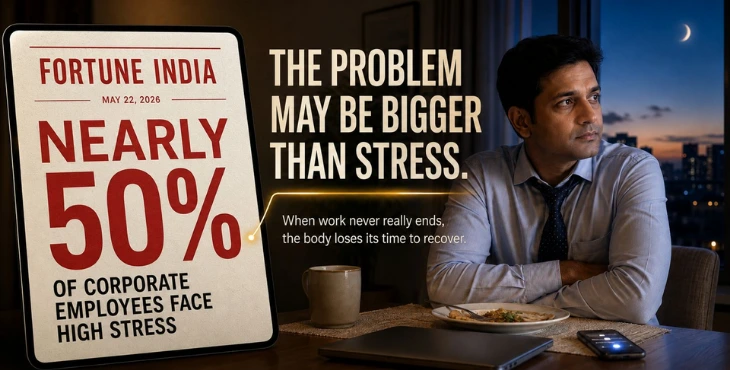
In May this year, Fortune India published an article on the growing “always-on” culture in Indian companies. The article is around three months old now. But the problem it talks about has certainly not gone away.
You can read this article in detail at the end of this blog
The article, based on a report by Cult, says that nearly half of corporate employees in India experience high levels of stress. Only 19% of those surveyed felt fully in control of the boundary between their work and personal lives.
That second number is the one that stayed with us.
Most working people know that stress is part of work. There are deadlines, difficult conversations, uncertainty and days that stretch longer than expected. But not feeling in control of where work ends is a different problem. It means that even after the laptop is shut, the person may not really have left work.
A message is checked during dinner. Tomorrow’s meeting is running in the mind while trying to sleep. The morning begins with the phone before the person has even got out of bed. None of this looks serious when seen as a single incident. The concern is what happens when it becomes the normal pattern of every day.
Stress is often felt through the body
When people hear the term “work stress”, they usually think of anxiety, irritability or burnout. But actually a person may experience it in less obvious ways.
They may not be sleeping as well as before. They may wake up tired, depend on more coffee to get through the day, eat at irregular times or feel that their digestion has become unsettled. Some people notice that their neck and shoulders are always tight. Others say that they are working for long hours but are no longer able to concentrate in the same way.
This does not mean that work stress is the cause of every sleep, digestive or energy-related problem. Persistent symptoms need proper medical assessment. But it is equally unhelpful to look at every complaint in isolation without asking what has changed in the person’s daily life.
If anxiety or emotional distress persists, explore UWAY’s mental and emotional health care.
Sleep affects energy and attention. A restless mind can affect sleep. Irregular meals and hurried eating can affect how a person feels after food. When energy falls, movement reduces and the working day can feel even harder. These are not four different lives. They are different parts of the same person’s day.
This is one reason Ayurveda has always given importance to dinacharya.
Dinacharya is more than a morning ritual
Dinacharya is commonly translated as “daily routine”. On the internet, it is often presented as a fixed list of things one must do early in the morning. That is a rather narrow way to understand it.
The more useful idea is that health is influenced by the way we live repeatedly—not only by what we do after a problem appears.
Ayurveda therefore paid attention to everyday matters such as waking, sleep, food, movement, personal care, work and rest. Dinacharya forms part of swasthavritta, the Ayurvedic approach to maintaining health. The Ministry of AYUSHincludes dinacharya within this wider self-care approach, while the World Health Organization’s benchmarks for Ayurveda training refer to daily and seasonal regimens relating to food, sleep and other activities.
Naturally, the classical texts were written in a world without emails, smartphones or video calls. We do not need to pretend that they described the modern office. What remains relevant is the attention Ayurveda gave to rhythm and repetition.
One good night’s sleep helps, but it may not correct weeks of poor sleep. A healthy Sunday meal does not change a pattern of rushed and irregular eating through the week. An occasional yoga class can be useful, but it cannot by itself create recovery in a day that has no real pause.
In other words, what we do once matters. What we do every day often matters more.
The modern workday has lost its edges
Earlier, travelling home created at least some physical separation between work and personal life. Hybrid and remote work have brought many advantages, but for some people that separation has become weaker. Work can now enter the bedroom, the dining table and almost every quiet moment in between.
The problem is not technology alone. It is the expectation of permanent availability that technology can create.
This is where the Fortune India article deserves attention. The report says that nearly 30% of professionals surveyed relied on coping behaviours such as stress eating and excessive screen time, while around 40% used fitness activities to manage work-related anxiety.
Fitness is valuable. Yoga can be valuable. Counselling can be valuable. But a one-hour intervention cannot carry the entire burden of a 24-hour pattern.
If sleep timing, eating, physical activity, mental stimulation and recovery are all being affected, it makes sense to look at them together. That is what “holistic” should mean in practice. It should not mean adding many therapies. It should mean understanding how different parts of a person’s life are connected and deciding what actually needs to change.
What does dinacharya mean for a busy professional today?
It cannot mean asking everyone to follow the same elaborate routine.
A person working across time zones, a mother balancing work and home, and someone who travels two hours to the office do not have the same day. Advice that ignores these realities will not last, however traditional or scientifically sensible it may sound.
A modern application of dinacharya has to begin with the person’s actual life. Where is the routine breaking down? Is sleep the first issue? Are meals being pushed around work? Does the person remain mentally stimulated until bedtime? Has movement disappeared from the day? Which small change is both useful and possible now?
The answer will differ from person to person. The purpose is not to create a perfect routine. It is to restore enough order to the day for the body and mind to recover better.
This is also the thinking behind UWAY Jeevan
UWAY Jeevan is a focused online Ayurveda programme created for busy people whose sleep, mind, digestion and energy may have started affecting everyday life.
These four areas are looked at together because that is how people experience them. Poor sleep can reduce energy and focus. An unsettled mind can make it difficult to sleep. Digestive discomfort can affect the whole day. Low energy can make even simple health advice difficult to follow.
In Jeevan, doctors assess the person’s medical context as well as these connected patterns. The intention is not to impose an ideal Ayurvedic lifestyle or suggest that routine alone can solve every health concern. It is to identify small, coordinated and medically appropriate changes that the person can realistically follow, with doctors and a care team staying involved during the process.
That is where the idea of dinacharya becomes practical for us. A consultation can provide direction, but any meaningful change eventually has to find a place in the person’s ordinary day.
Companies cannot place the whole responsibility on employees
There is another side to this discussion.
No individual routine can fully compensate for unreasonable workloads, unnecessary calls after working hours or a culture in which being constantly available is treated as commitment. If the organisation keeps disturbing recovery, employee wellness cannot be reduced to asking people to meditate, exercise or manage their time better.
Companies have a responsibility to look at workload, job design, manager behaviour and communication outside working hours. Employees, at the same time, need access to credible support that goes beyond a health talk or an annual wellness event.
The Fortune India article says that organisations are increasing their spending on corporate wellness. That is encouraging. But participation in a programme is not the same as improvement. The more useful question is whether employees are sleeping better, feeling more energetic, managing their health better and recovering sufficiently to return to work the next day.
The “always-on” work culture is usually discussed as a mental-health or productivity issue. It is both. But it is also a daily-life issue.
Ayurveda’s emphasis on dinacharya reminds us to look at the whole day—not only at the hour in which a person exercises, meditates or speaks to a doctor.
Because work may officially end at a certain time. Recovery does not begin automatically.
Link to the article: https://www.fortuneindia.com/business-news/nearly-50-of-corporate-employees-face-high-stress-as-always-on-work-culture-fuels-anxiety-report/139256
The views and interpretations expressed in this article are those of the author and are intended for general informational purposes only.
About Author

Dr. Vasudha M Sharma
Dr. Vasudha M Sharma is an experienced ayurvedic doctor with 24 years of clinical experience, known for bridging Ayurveda, Yoga Therapy, and Acupuncture to treat complex, chronic conditions.
She completed her B.A.M.S. from Government Ayurvedic Medical College, Bangalore(1999), and M.Sc. in Yoga Therapy from SVYASA University (2005). Her passion for evidence-based Ayurveda led her to earn a PhD in Yoga from SVYASA University, where her doctoral research focused on integrating Ayurveda and Yoga Therapy in the management of Migraine headaches. She also presented her research work in the American Headache Society’s Headache Congress in 2019